
Introduction
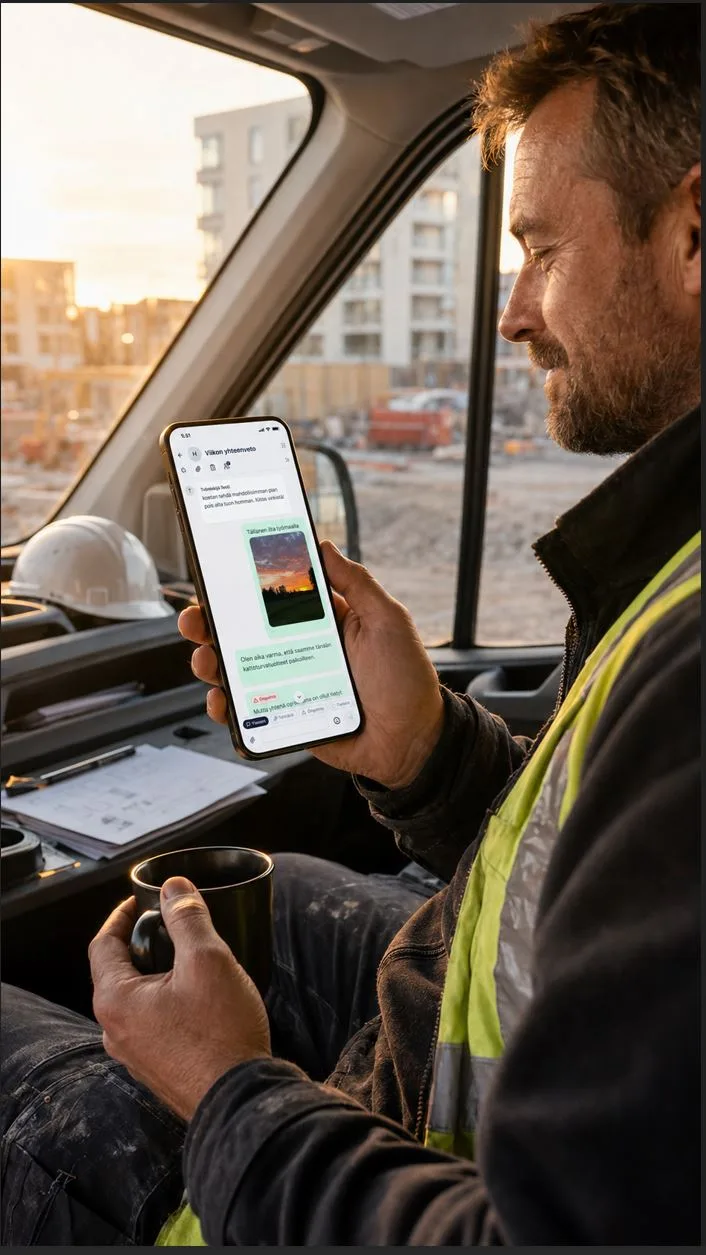
Site communication has moved to instant messengers, and in practice that usually means WhatsApp: a group for every site, with the foreman, the installers and often the subcontractors too. It is fast, familiar and free — and precisely for that reason it has quietly become many companies' most important information management system.
The problem is not the communication itself, but what happens to the information after the message is sent. In this article we go through the most common pitfalls of site communication — decisions buried in threads, photos scattered across phones and the language barrier — and what a working solution looks like.
Where instant messengers fail
WhatsApp, Telegram and text messages were designed for free-form conversation, not for managing a project. In site use the limits appear quickly:
- Information drowns in the thread. An agreed change or additional work is under hundreds of messages within a couple of days. Search knows nothing about projects or tasks — only words.
- Groups multiply uncontrollably. The same thing is agreed in one group and overturned in another, and nobody knows which group is the "official" one.
- History leaves with people. When an employee changes companies or a phone breaks, the conversation history — and the agreements in it — can be lost for good.
- Work and free time mix. Work matters travel in the same app as family messages, and the company has no control over its own information.
Photos: the most valuable documentation scattered across phones
Site photos are a small company's most valuable documentation. They prove what was done, when, and what condition the site was in before work started. In an instant messenger, however, a photo is saved to the sender's and recipients' phone galleries with no link to the project.
When the photos are then needed — for a complaint, for invoicing additional work or for a warranty question — they are dug out of someone's personal gallery or found by scrolling months of message history. Often the decisive photo is on the phone of the very installer who no longer works for the company.
The language barrier is the site's silent risk
A significant share of the construction site workforce has a foreign background — estimates hover around one fifth. On Finnish sites you hear Estonian, Polish, Ukrainian and Russian daily, yet communication still runs almost exclusively in Finnish or English.
A misunderstood instruction is not just an efficiency problem but a safety risk: an unclear assignment or warning can lead to mistakes and dangerous situations. In practice many people confirm they understood even when part of the message was left to guesswork.