
Introduction
Once the basic logging is in order, time tracking can rise to the next level, becoming a real-time management tool that connects site events to invoicing, payroll and tax authority reporting automatically.
In this article we go through what integrations mean in practice and how they change the daily management of a small construction company.
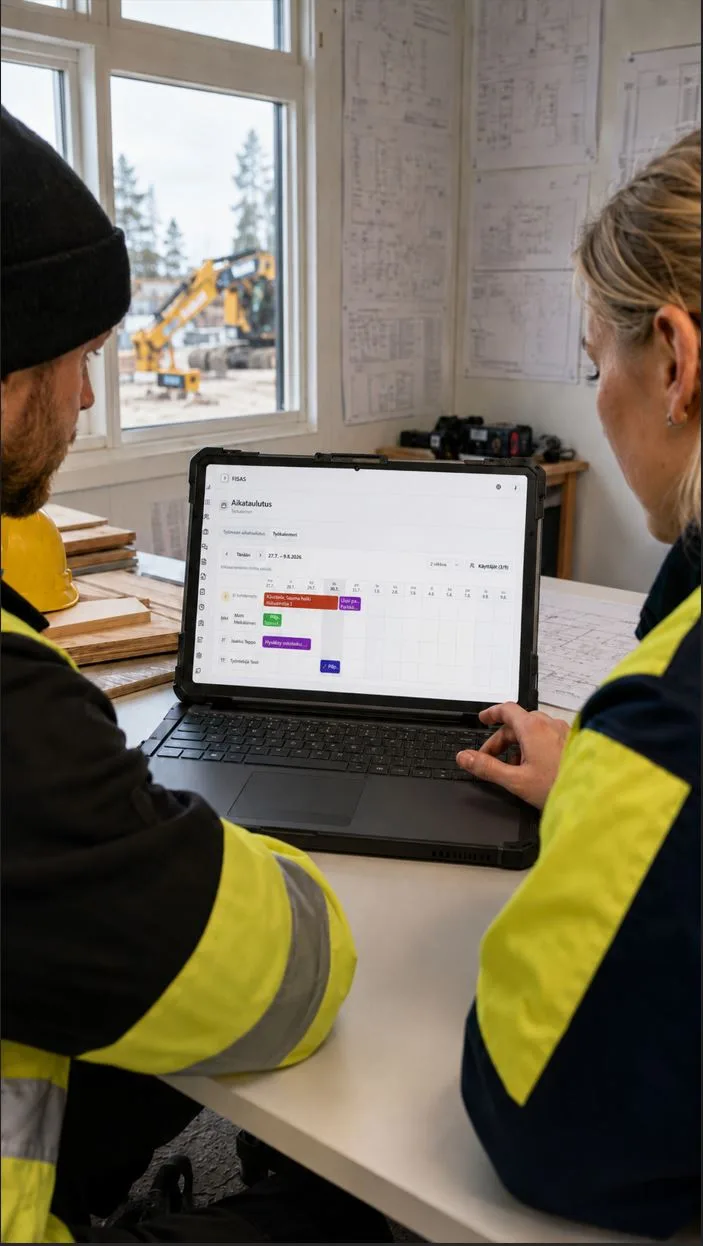
What does integration mean in practice?
Time logging without integrations is collecting data into a silo. The data exists, but it has to be moved by hand to payroll, cost tracking and invoicing. Every transfer is at the same time a new chance for error.
In an integrated system the same entry flows onward automatically:
- To cost tracking, where the project's hour cost updates in real time.
- To invoicing, where an hourly invoice is created without manual compilation.
- To payroll, where hours are ready for approval and do not need to be gathered separately.
- To tax authority reporting, into which the details for the personnel report accumulate on their own.
Real-time tracking as a management tool
In the traditional model a project manager gets a cost report once a week or once a month. Deviations are reacted to afterwards, and often too late.
Real-time tracking flips this logic, because a deviation appears on the very day it arises. If a project burns hours 30% faster than planned, the project manager knows it immediately and not only when the final invoice arrives.
A practical example: A water damage renovation exceeds its hour budget already in the third week. With real-time tracking the project manager notices it at the end of week three and can agree additional invoicing with the client in time. Without real-time data the same thing only becomes clear in week eight, at the final invoice.