
Introduction
Over 60% of Finnish construction companies still use Excel-based cost tracking or a separate accounting program that is not connected to the projects' real situation. Knowing a project's margin accurately requires manual compilation of hours, which is often done only when the project ends.
Real-time cost tracking changes this fundamentally. In this article we go through what it means, what it requires and what it gives a small construction company.
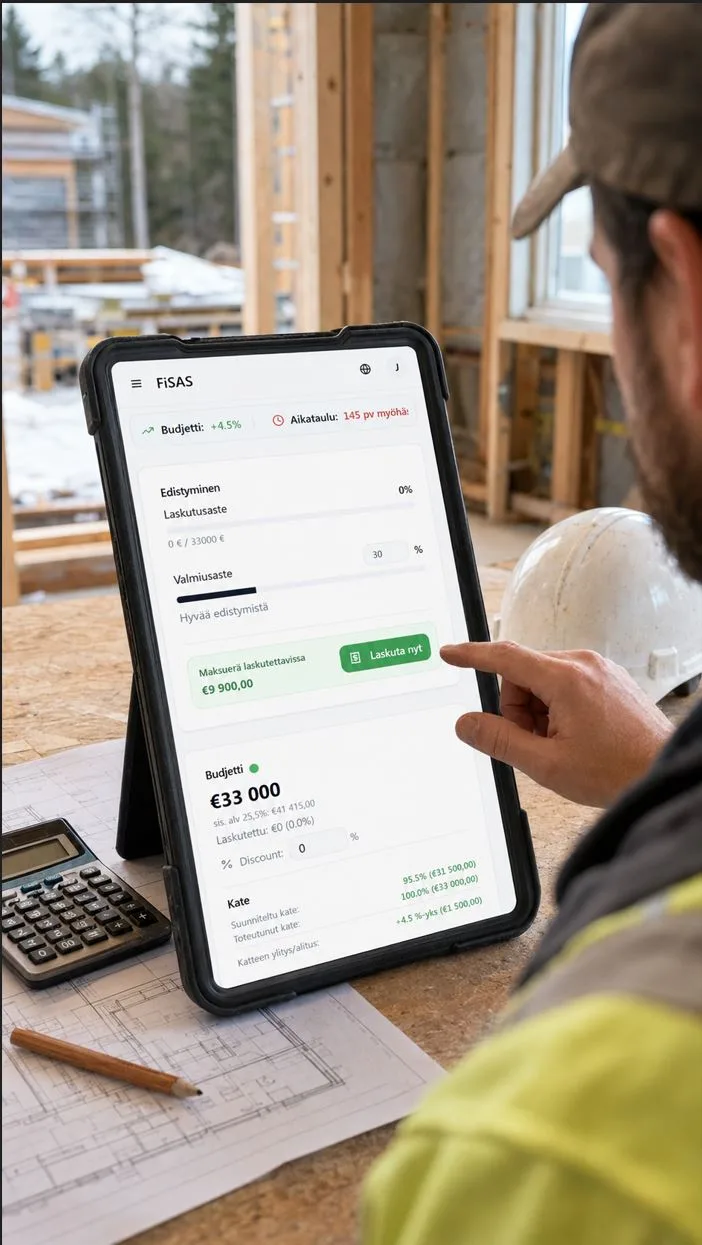
Why does cost tracking fail without real-time data?
Traditional cost tracking works like this: work hours are gathered into payroll at the end of the month, material invoices are entered into accounting with a delay of weeks, and the margin analysis is done after the project ends.
In this model the project manager drives looking in the rear-view mirror. Deviations are reacted to afterwards, when the damage is already done, and budget overruns only become clear at the final invoice.
In a real-time model the same data is available daily:
- Work hours are logged on mobile, and they show in cost tracking right away.
- Material orders are logged to projects, so the margin updates automatically.
- Subcontractor invoices are allocated to projects, so the project-level margin stays up to date at all times.
What does real-time tracking require?
Real-time data does not come from software alone, it also requires a change of process:
- Hours are logged daily, not as a single sum at the end of the week.
- Material purchases are logged to projects right when ordered, not through accounting with a delay of weeks.
- Subcontractor agreements are in the system, so allocating invoices is automatic.
The change is small, but it requires management's commitment and clear guidance for the whole team.